Have you ever wanted to be pushed—I mean really pushed, pushed really hard?
I have.
But not to do more pushups or to climb harder. I wanted to be pushed inward, to be directed to keep going toward the truth.
I meditated and philosophized for countless hours, but I never found that pusher, that mentor, that Athlean-X for the spiritual life.
Nobody ever told me, “Toughen up and face it. Get after it. Now, do it again.”
So, I decided to make one: to make it tough on myself to see what I was truly made of.
If you want a strong sword, first you’ve got to heat, forge, harden, and then temper the steel.
* * *
Let’s have some fun: what would you get if you crossed Sam Harris, a proponent of Eastern spirituality, with Jocko Willink, your Navy SEAL tough guy? Or if you mixed Socrates with Alexander the Great? Or the Vedantic philosopher Shankara with the Buddhist king Ashoka?
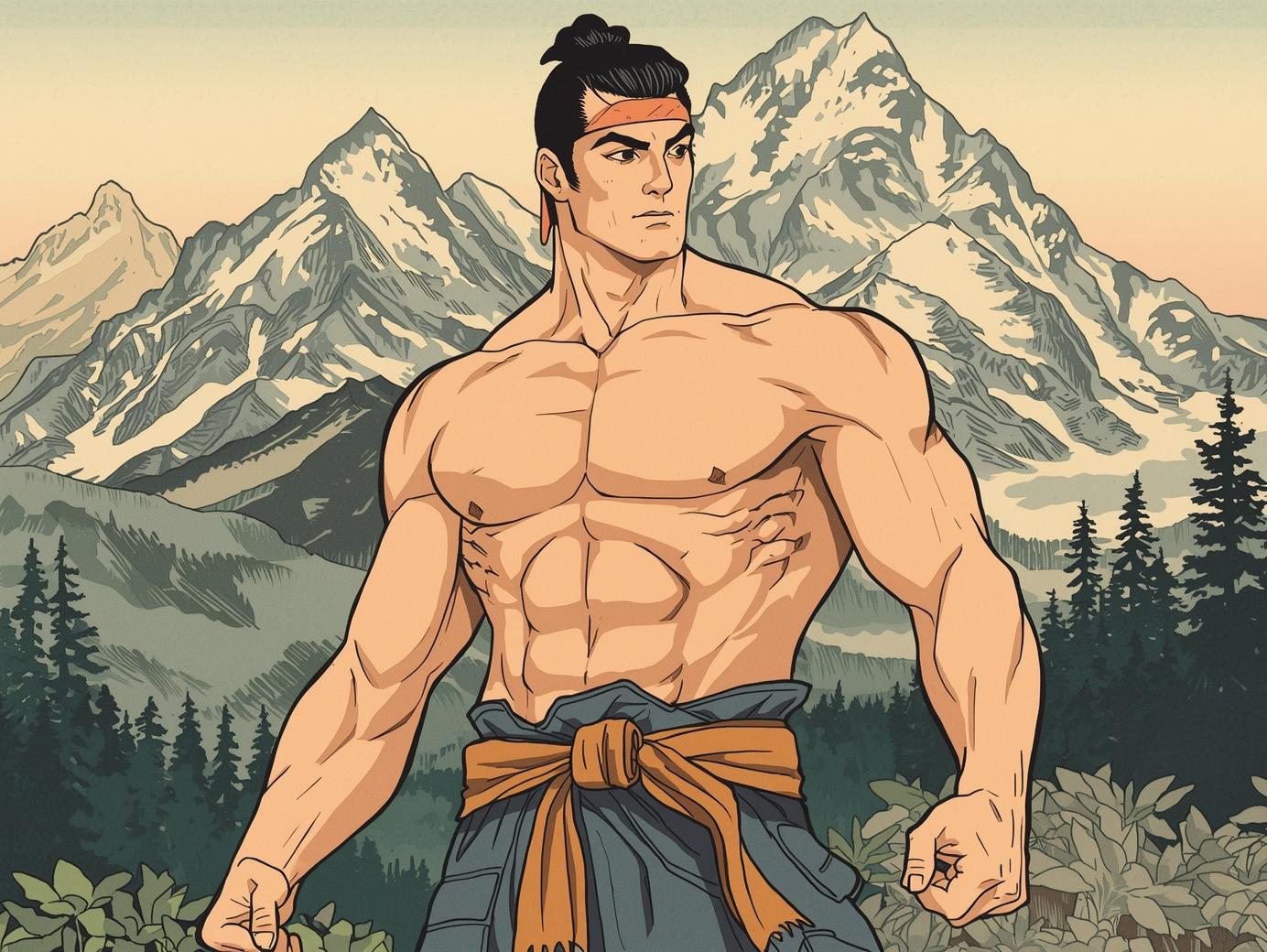
You’d get “rugged spirituality”: a synthesis of philosophical sharpness with the warrior ethos. Intelligent rigor would weigh as much as intense effort; metaphysical clarity in equal measure with mind training; truth-hunger proportional to at-your-limit discipline.
“OK, brother, let’s say you can actually do that—so what?”
Two reasons. The first existential: lots of guys have discovered that they have everything (family, a good income, respect from peers, etc.), and yet they’re not fulfilled. Now what? What’s fundamentally missing?
The second historical: some think that the next 6 months to 2 years could bring about a massive AI disruption. Who knows, but suppose there’s something to this. Tell me: how are you gonna live clearly and with fortitude without giving into a restless, agitated mind—without, that is, freaking out or frittering away?
Rugged spirituality means going deep into who you really are as well as honing the chief instruments—mind, energy, intellect, will—along the way.
I didn’t start here. I had to get here.
* * *
My journey through the landscape of contemporary spirituality has been soft and perplexing. Consider a choice sampling:
In Idyllwild, CA, my wife Alexandra and I took part in the Way of Council, a sharing circle in which one “keeps it lean” and “speaks from the heart.”
In Ventura, we chanted in unison with a warped and wobbly tape recording of monks chanting, some years prior, at Mount Shasta Abbey.
In Boulder, a group of us sat zazen in silent protest of fracking as cheery hikers walked awkwardly past us.
In Santa Fe, a Zen teacher cried while strongly implying that he wasn’t fit to be a leader.
In Southern California, we watched as wealthy older people took their afternoon naps and the spiritual teacher, ostensibly leading body yoga, fell asleep.
In Garrison, NY, a participant at a weeklong retreat was adamant that one simply be aware while another breezily spoke of “the knowing.”
In Zoom sessions, faces glowed weirdly with “that ethereal look.”
In short, alotta performance art.
I didn’t want to be held, seen, or supported. I wasn’t looking to feel good or to bliss out or to try out the latest psychotechnology.
I didn’t want more modalities; I wanted truth, the peace that sticks. And for that, I needed to be pushed, something I ultimately found from within.
In contrast, what’s contemporary spirituality’s main message? Get some altered states, have some cool experiences, be held, feel supported, and, above all, embrace sentimentalized group therapy.
That’s right: sentimentalized group therapy.
* * *
In 1981, Alasdair MacIntyre told us that the therapist, a dominant modern character, couldn’t help us to interrogate the conception of the good life but instead shifted the session toward how we “emotivist selves” could fulfill our desires while “coping” with modernity. Before then, in 1966, Philip Rieff foretold “the triumph of the therapeutic”: the demise of a strenuous religious worldview and the birth of “psychological man” who’s oriented toward well-being.
Both nailed Instagram, and here we are.
Sentimental therapeutic spirituality comes in two forms: dark and light. On the darker side, you get Neo-gnosticism: having fallen into corporeality and without hope of exit, you find a planet dying, fluctuating post-1960s group identities not fully recognized, empires ruling with soft and hard power, wars breaking out, capitalism cutting folks down…
You get purgatory.
And all you’re left with is navigating collective grief over death, destruction, entropy. The sentimentality, here, is expressed in contingent solidarity forged through emotional intensity. Collapse is coming: let’s cry together.
The lighter side is bhoga yoga, a thinly disguised noble nihilism. It’s the way of enjoyment for neoliberal, wealthy elites and digital nomads who hear that everything, idly, is “presence,” “peace,” or “the gift-dispensing universe.”
You’re buoyed up by sound baths, cacao ceremonies, ecstatic dancing. Here’s the barely concealed hedonic life.
Imagine: no metaphysics, no practices, no paths, no selves here, just presence or vague benevolence. Pretense, actually. Be sentimental: get high, feel elated, and make believe that it’s something deep, possibly unique.
What both versions share is an anti-soteriological, anti-metaphysical commitment to group therapy. Nix the vigorously laid out doctrine of salvation, and call off the relentless metaphysical probing into—what’s the world? the mind? the self? the infinite mind? the ultimate aim?
Instead, contemporary spiritualists, defaulting to “experientialism,” talk in terms of felt or lived experiences: dark solidarity or light jouissance.
So, either consolation or ethereality, and in both: a sea of nodding heads.
* * *
We can’t skimp on Jocko because Mr. Harris alone lacks inner power. Intellection? Yes. But real oomph, magnanimity, boundless cheerfulness? Not so much.
And we can’t just go for Mr. Jock-o since he’s not scrutinizing, as is evident in his
famous teaser video, what “bad” and “good” are or, more generally, what he got from American New Thought pragmatism. He’s punting on the big stuff.
To paraphrase Kanye West: “We want it all.”
So, rugged spirituality must take both the philosopher and the warrior seriously. The philosopher has got to know what’s real, what’s true, what it’s all about. And the warrior must test himself through hardship, setbacks, ordeals.
The philosopher has to be unimaginably, almost ruthlessly clear. Meanwhile, the warrior can’t do without challenges that fortify his character, optimize his inner power, and pitch him forward.
The truth is light and fire, and the door is flung open to anyone committed to light and fire, knowledge and discipline, clarity and self-control.
 Andrew Taggart, Ph.D.
You must be logged in to post a comment.