Gibson’s Heroics
Kirk Gibson was supposed to be in the trainer’s room when millions of us saw him limp to the plate with two outs in the bottom of the ninth of Game 1 of the 1988 World Series, and the Dodgers down by a run.
It’s a long, fierce at-bat against star closer Dennis Eckersley: 7 agonizing minutes. Gibson is noticeably wincing as the count goes to 0-2. He fights, parries, spars to 1-2; then 2-2; finally 3-2. By now, Mike Davis has stolen second, and the best-case scenario is for Gibson, who is virtually legless, to punch something past the infield.
Improbably, he lifts the ball just past the right-field fence for a two-run, game-ending home run. Grinding round the diamond, he yanks the bow–once, twice–and is mobbed by his teammates at home plate.
James’s Challenge To Pacifists
I found myself returning to this scene as I began to think about two seemingly unrelated questions. First, could there be a connection between the warrior ethos and an emergent form of spirituality? And, second, which moral virtues got erased as technological society won out?
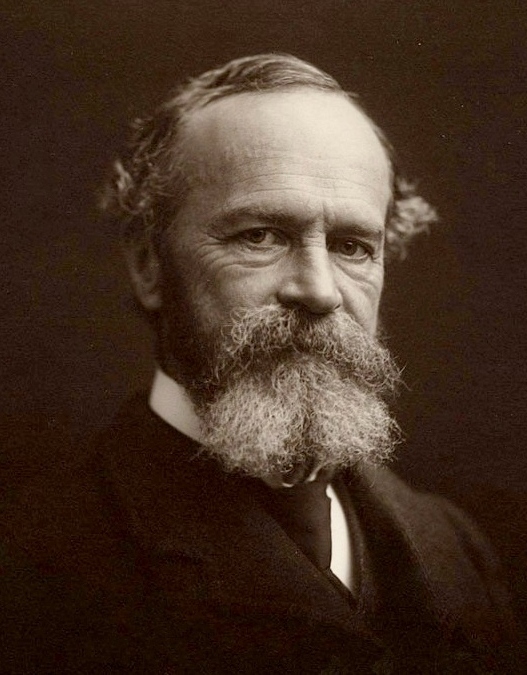
William James, a pacifist with a twist, didn’t pander to his audience. In 1906, he delivered a muscular public lecture, “The Moral Equivalent of War,” in which he told his fellow pacifists that their position wasn’t philosophically defensible.
He doesn’t deny that technological war, evident in the Russo-Japanese War of 1904-1905, is both costly and deadly, the consequences terrifying. Yet neither a bourgeois ethos of commerce nor a socialist commitment to equality can replace the honor ethos of glory. Hence, while war itself is repugnant, the hardiness shaped by war is laudable.
His crescendo–that “[t]he martial type of character can be bred without war”–brings us to his civic solution: conscripting young men in a mandatory public works campaign in a “war” “against Nature.” Hard labor to build railroads and erect dams: our young men, rich and poor alike, shall become hearty and hale by turning recalcitrant environments into public works.
James’s diagnosis is brilliant, yet his solution is an utter failure. For one thing, it’s a stretch to cast nature as an enemy, so the struggle is, at best, only against fatigue or boredom. For another, there’s no fear of death, and facing death figures prominently in the warrior’s life. Finally, a civic ideal, however estimable, doesn’t cultivate martial virtues, only civic or bourgeois ones.
Sports Are Not The Solution
In an effort to maintain the honor ethic in the absence of war, we turned to sports. We took a shot at the problem–but we got it wrong.
Even though sports may seem to cultivate the warrior ethos, they can’t. True, teams vie for victory or fall in defeat; loyalty is formed, enemies created; players rise to glory or choke; a season may be marred by setbacks, injuries, lack of team chemistry; and if players are to succeed, they must learn to gel and perform cohesively despite clashes in personality or changes in personnel.
Then why can’t sports work?
Because sports are closed, finite games whereas life is an open, infinite game. Losing on the field tells me almost nothing about how to face aging and death, and my determination to win doesn’t spill over into my zest to know myself. Moreover, as the body ages and injuries accrue, I lose the ability to keep playing. Consequently, “warrior-lite” virtues cultivated in the bounded, rule-governed space of a court aren’t transferable to the unbounded, ethically rich space of ordinary life.
We all know this, intuitively. Few of us who’ve played sports feel that we are hardy when pressed by life’s greatest challenges, and the greatest sports figures often make a hash of living.
The Spiritual Equivalent of War
Our greatest battle, one left untouched by James, is metaphysical, not social in character. Beyond working dams and transcontinental railroads, beyond social cooperation itself, there dwells an adversary: the mind wearing the mask of a trickster.
That’s why we need the spiritual equivalent of war. In rugged spirituality, the mind becomes the site in which ego tendencies–nasty dislikes, endless cravings, seemingly interminable dissatisfaction–are fought and ultimately vanquished. Courage, truthfulness, rigor, a reckoning with pain: these virtues and others shall be tested again and again as the mind rages, flails, parries, and ultimately submits. Yoga Vasistha puts it well: “[T]he wise man grinds his teeth and strives to conquer his mind and senses: such conquest is far greater than conquest of external foes.”
In 2015, Kirk Gibson, 57, found out that he had Parkinson’s Disease. In his public statement, he said, “I have faced many different obstacles in my life, and have always maintained a strong belief that no matter the circumstances, I could overcome those obstacles.”
However, this obstacle–the tightening grip of finitude–is different and deeper than Gibson lets on. Turning inward, he would have to confront that I-sense, that ego-I, on whose behalf there is the fear of decay, the stiffening of the limbs, the imminent prospect of mental decline, the lights growing dimmer and dimmer. In his final act, he would have to grind his teeth and strive to conquer not Eckersley but his mind. His triumph over the ego, though unwatched and without any fist pumps, would be far greater than any World Series victory.
It would be miraculous. Supreme peace.
 Andrew Taggart, Ph.D.
You must be logged in to post a comment.